Government Stability at Risk Amid Political Deadlock
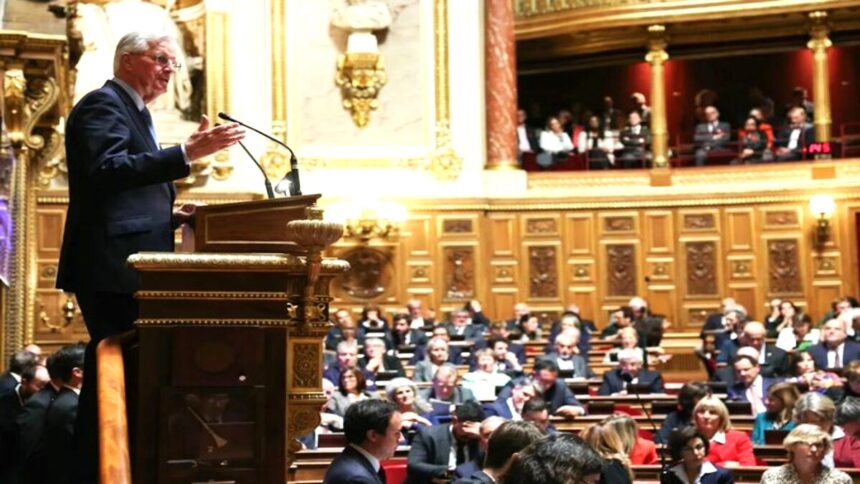
Prime Minister Michel Barnier of France is facing a critical moment as he navigates a turbulent political situation over the country’s budget. On Monday, Barnier pushed a budget bill through the lower house of Parliament without a vote, triggering the possibility of a no-confidence motion that could bring down his government. The move is seen as risky, not just for Barnier’s future but for the stability of the entire government, as it threatens the passage of a crucial budget that the country must finalize before the year ends.
Financial Market Reactions and Economic Concerns
The uncertainty surrounding the budget has sparked widespread anxiety, particularly among financial markets. The potential collapse of the government and the failure to pass a budget could further destabilize France’s already fragile economy. Borrowing costs for the country have already surged, and analysts warn that continuing political chaos could deepen economic troubles. The country’s already high debt-to-GDP ratio and spiraling deficit are under scrutiny from the European Union, which has urged France to take swift action to stabilize its finances.
PRIME MINISTER BARNIER BYPASSES THE FRENCH PARLIAMENT to pass his social security budget
This means that a motion of no confidence will likely get the support from both the left and far-right RN -> majority
As no elections can be called till July, there’ll be a stalemate again https://t.co/RQ5iMz7rMI
— Nassreddin 🍉 نصر الدين (@Nassreddin2002) December 2, 2024Political Deadlock and the Far-Right’s Influence
The situation is exacerbated by the political deadlock that has gripped the French National Assembly since the snap elections last summer. No party has been able to secure a majority, leading to a fragmented Parliament. The lower house is divided into three main factions: the far-right National Rally, led by Marine Le Pen; a left-wing alliance known as the New Popular Front; and a more centrist group that supports Barnier’s government.
Barnier, appointed by President Emmanuel Macron just three months ago, was tasked with navigating this division and steering the government forward. However, the absence of a clear majority in the Assembly has left him reliant on the far-right National Rally for support. This alliance, while crucial to Barnier’s survival, has also placed him in a difficult position. Le Pen’s party has wielded significant power in the negotiations, and Barnier has been forced to make concessions to avoid a no-confidence vote.
Le Pen’s Demands and Barnier’s Concessions
Over the past week, Barnier and Le Pen have engaged in a tense back-and-forth. Le Pen has made it clear that she would vote to bring down the government unless Barnier made further concessions, particularly on the budget. Barnier, in turn, has warned that failure to pass a budget would have serious consequences for France’s financial markets and the country’s ability to function in the coming year. Yet Le Pen has dismissed these warnings, accusing the government of using scare tactics.
In an effort to avoid an impending crisis, Barnier made a series of concessions, including scrapping an increase in electricity taxes and reducing healthcare coverage for undocumented people. However, these changes did little to appease Le Pen, who remained firm in her stance. In a final attempt to placate the far-right, Barnier promised not to reduce medication reimbursements, but Le Pen and her party were unimpressed.
Uncertainty Around the Government’s Future
As the political stalemate continues, the future of Barnier’s government hangs in the balance. The National Rally has made it clear that unless Barnier concedes further, it will join forces with the left-wing opposition to vote him out. If this happens, it would set off a chain reaction that could bring down Barnier’s cabinet and force President Macron to appoint a new prime minister. While Macron will remain in office, the appointment of a new prime minister would mark another upheaval in an already unstable political climate.
Political analysts have expressed concerns over the lack of direction and clarity in the country’s future. “We won’t have a budget, we won’t have a government — there is no sense of the day after,” said Nicole Bacharan, a political scientist based in Paris. The fragmented political landscape and the inability to pass crucial legislation have left many wondering what the future holds for France.
The Symbolism Behind the Budget Crisis
According to Benjamin Morel, a lecturer in public law at Panthéon-Assas University, the real issue behind the budget crisis is not necessarily the specifics of the proposed cuts or tax hikes but the symbolism behind the political deadlock. “This blockage is not so much about the measures, which were expected, particularly on electricity. It’s really about symbolism,” he said. The inability to push through key legislation and the prospect of a government collapse could have serious electoral consequences, particularly for Barnier’s government, which has struggled to navigate the fragmented political scene.
The Strain of Austerity Measures
The budget itself is a contentious issue, with austerity measures at its core. Barnier’s government is tasked with cutting public spending by 60 billion euros ($63 billion) to address France’s growing debt and deficit. The proposed cuts, alongside increases in taxes, have proven highly unpopular with the French public. Recent polls show that the majority of the French population opposes the austerity measures, and a small majority wants Barnier’s government to fall.
This widespread opposition adds another layer of pressure to an already fragile government. Barnier could have allowed the bill to go to a vote on Monday, continuing the legislative process, but with the constitutionally mandated deadline to finalize the budget looming, he felt he had no other option but to push the bill through using Article 49.3 of France’s Constitution. This article allows the government to bypass a vote on a bill, but it also gives opposition lawmakers 24 hours to file a no-confidence motion. If the motion passes, Barnier and his cabinet would have to resign, forcing Macron to appoint a new prime minister.
The Road Ahead: More Political Strife
The use of Article 49.3 is not limited to this one bill. There are two more major budget-related bills that Barnier will need to navigate in the coming weeks. The next bill, adjusting 2024 finances, is expected to be voted on later this week, and the main 2025 government budget will come up for a vote around December 20. In each case, the political deadlock in the National Assembly looms large, and the use of Article 49.3 is likely to lead to more no-confidence votes, further testing Barnier’s ability to retain control of his government.
In the event of a no-confidence motion, if an absolute majority in the National Assembly votes in favor, Barnier and his cabinet will have no choice but to resign. This would lead to further political instability and a potential reshuffling of government leadership, with President Macron once again at the center of the decision-making process.
As the clock ticks toward the end of the year, all eyes are on Barnier, Le Pen, and the fragile coalition holding France’s government together. The country is at a crossroads, and the political drama unfolding in the National Assembly will have profound implications for its future stability and economic outlook.
Read More : Unprecedented Protests Erupt in Georgia After Suspension of EU Membership Bid